

Is Gulmarg Safe? What the Advisories and the Mountain Say
Two questions, not one. On the region, four governments — the UK, the US, Australia and Canada — advise against travel to Jammu and Kashmir, and the UK names Gulmarg. On the mountain, about 99% of Gulmarg is unpatrolled off-piste terrain, and every fatal avalanche on record happened there rather than on the beginner slopes.
Advise against travel
4 governments named below
Ski patrolled
1 bowl of eighteen
On our course
3 students per instructor
Ask whether Gulmarg is safe and you will be given two answers, both stated with total confidence, by people who are not talking about the same thing. One of them is a government position. The other is what the travel industry says, including us.
Do not travel to Jammu and Kashmir. That includes Gulmarg.
Held, in substance, by four governments.Gulmarg is completely safe. Thousands of visitors go every winter.
Said by operators selling what we sell.The honest answer is not somewhere between them. They are answers to two different questions that have been given the same name, and until those are separated neither one helps you decide anything.
Two questions, not one
“Is Gulmarg safe” collapses two unrelated questions. One is about a region and its politics, answered by governments. The other is about a mountain and its snow, answered by a ski patrol. They have different evidence, different authorities and different answers, and mixing them produces a bad decision.
Is the region safe to travel to?
Who answers it
Foreign ministries — the UK, US, Australia and Canada
The evidence
Published travel advisories , updated on their own schedule
Our standing
None
Answered in
Section 02, in full
Is the skiing safe to do?
Who answers it
The Gulmarg ski patrol — and its snow safety officer
The evidence
Patrol figures, a daily avalanche advisory, an incident record
Our standing
We operate on this mountain
Answered in
Sections 03 and 04
The two columns do not average out. A confident answer to one of them tells you nothing about the other.
The one we are not qualified to answer
We are a tour operator with a commercial interest in your booking. No assurance from us should carry weight against a foreign ministry, and we are not going to offer one.
What we can do is print what those ministries actually say, in full, including the parts that cost us money. That is the next section, and it is the longest on this page for a reason.
The one that has a real answer
The mountain question is different. It has published figures, a named ski patrol, a daily avalanche advisory posted where you can read it, and a public record of what has gone wrong and where.
That question can be answered properly, and the answer is more useful to you than any reassurance. It also turns out to depend almost entirely on which part of the mountain you are standing on — which is a different article's subject too, in can a complete beginner learn to ski in Gulmarg.
What the travel advisories actually say
Four governments currently advise against travel to Jammu and Kashmir. The UK advises against all travel to the union territory and names Gulmarg explicitly. The United States rates it Do Not Travel. Australia and Canada say the same in their own wording. None of it binds you, and all of it should inform you.
Where four governments stand on Jammu and Kashmir
Their words, not ours| Government | Position | Names Gulmarg |
|---|---|---|
| United Kingdom | Advises against all travel to the Union Territory of Jammu and Kashmir | Yes |
| United States | Level 4 — Do Not Travel — for Jammu and Kashmir | Not by name |
| Australia | Do not travel to the Union Territory of Jammu and Kashmir | Not by name |
| Canada | Avoid all travel to the Union Territory of Jammu and Kashmir | Not by name |
Each of the four is written for the whole union territory, not for one ski village. That is a limitation of the advice, not a loophole in it.
The UK position, in full
The Foreign, Commonwealth and Development Office advises against all travel to the Union Territory of Jammu and Kashmir. Its list names Pahalgam, Gulmarg, Sonamarg, the city of Srinagar and the Jammu–Srinagar national highway.
Three exceptions sit outside that advice.
- Travel by air to and from the city of Jammu
- Travel within the city of Jammu
- Travel within the Union Territory of Ladakh
Two consequences follow, and both are in the FCDO's own words rather than ours.
Travel insurance can be invalidated by travelling against FCDO advice. That applies whatever the policy says about skiing.
The consular assistance the British High Commission can provide inside Jammu and Kashmir is severely limited.
Read it yourself on the FCDO's India travel advice. It changes, and the version on the day you book is the one that matters.
Who this applies to, and who it does not
An advisory is a government's guidance to its own nationals. It is not a border closing, and it is not a law.
Travelling on an Indian passport
None of the four applies to you. Most of our guests are domestic, and for them the useful question is the mountain one in the next section.
Travelling on a UK, US, Australian or Canadian passport
Read your own government's page before you book anything — then read your insurance policy next to it. The invalidation clause is the part that costs money.
We are not going to tell you what to conclude from any of that. It is a decision that belongs to you, made with the source open rather than with our booking form open.
On the mountain: the ski area and everything else
Gulmarg has one patrolled bowl out of eighteen. About 99% of the mountain is off-piste terrain with no avalanche control, slopes averaging around 38 degrees, and over 14 metres of snow a year. A beginner course never goes there. Every fatal avalanche on record happened in that terrain.
One mountain, three different safety regimes
A simplified profile from the village to the top station. Heights are approximate and not to scale.
The word “Gulmarg” covers all three. That is the whole problem with answering the question in one sentence.
One bowl of eighteen
Gulmarg's own ski-safety guidance is blunter about this than any tourism page. Roughly 99% of the mountain is off-piste and not patrolled. Of eighteen bowls, one is patrolled — Gondola Bowl, at Mary's Shoulder — and explosives are used there for avalanche control.
Brian Newman, the contracted snow safety officer who has worked at Gulmarg with its Kashmiri ski patrol for well over a decade, draws the line the same way. He describes the mitigation inside the ski area as having achieved relative safety from avalanches there, and the terrain beyond it as unmanaged, with no avalanche safety measures.
The backcountry is unmanaged terrain. We refer to it as wild terrain.
Brian Newman · Snow safety officer, Gulmarg ski patrolThat is the distinction the word “Gulmarg” hides. The mountain is not one place with one safety rating, and a sentence that treats it as one is wrong whichever way it leans.
What the record shows, and where it happened
Three fatal avalanche incidents involving skiers are on the public record.
Fatal avalanche incidents on the public record
| When | What happened | Where |
|---|---|---|
| Feb 2018 | One Russian skier killed, four rescued. The state tourism director said the group had ignored an advisory to stay clear of an avalanche-prone area | Gulmarg upper slopes |
| Feb 2023 | Two Polish skiers killed; 19 foreign nationals and two local guides rescued. Three teams had gone up that morning | Apharwat |
| Feb 2024 | One Russian skier killed, six people rescued, a local guide among them, by the Gulmarg Ski Patrol and police | Kongdoori and Khilanmarg |
Compiled from news reports and official statements. Three incidents is not a rate — there is no published visitor denominator to divide them by, and we are not going to invent one.
Every one of them happened in the upper mountain. None happened on the nursery slopes at the base, which is where a beginner course spends its week and where the graduation run from Phase 1 finishes. That is not an argument that Gulmarg is safe. It is an argument that the risk lives in a specific place, and that beginners are not in it.
The advisory you can actually check
The Gulmarg Avalanche Center publishes a daily advisory through the season, issued by the snow safety officer and run in partnership with the Jammu and Kashmir Department of Tourism. The same advisories are posted at the gondola base, the mid-station and the top station, and a free avalanche awareness talk runs weekly in season.
It is worth knowing the centre closes when the season does and resumes in December, so a blank advisory in June is not a reassuring silence — it is a closed office.
You will also, at some point, see a video of an avalanche at Gulmarg and assume the worst. Some of them are deliberate. In January 2025 the ski patrol triggered one by controlled blasting at Kongdoori and Apharwat, described by officials as routine winter practice to prepare slopes and reduce later risk.
That is what mitigation looks like from the outside, and it is the same work that keeps the one patrolled bowl patrolled.
What we actually do
Eight protocols, all specific enough to hold us to. A maximum of three students per instructor, vetted and certified instructors, full safety gear, a mandatory briefing before every session, daily weather and avalanche checks with the power to suspend, first aid and CPR training, a doctor on call, and cover for emergencies and evacuation.
The one that does the most work
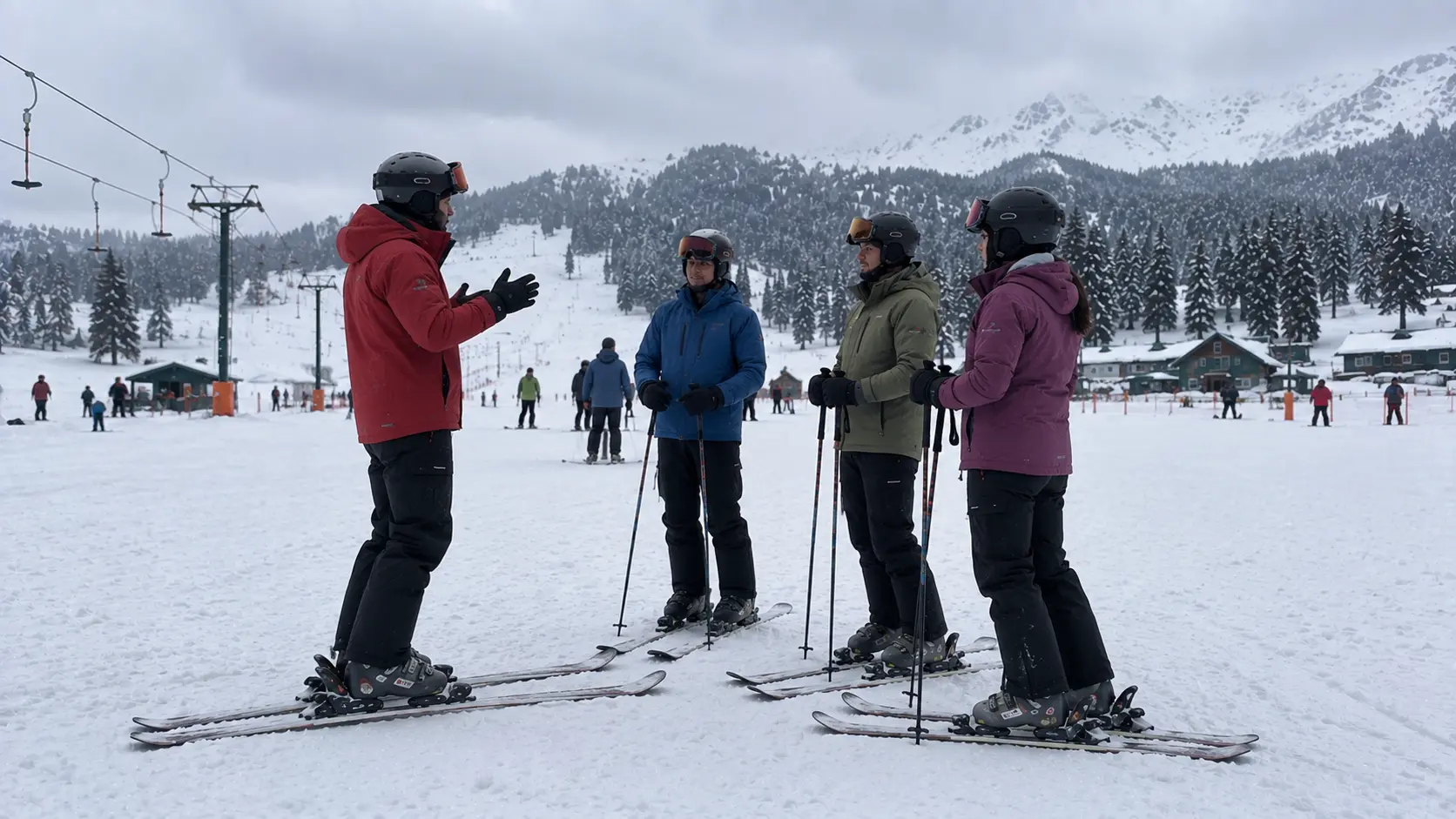
Three students to an instructor is the protocol everything else rests on. An instructor with three people in front of them can see all three at once, all the time.
That is what turns a fall into a correction rather than an incident. With ten students, the same fall gets noticed on the way back up the lift, which is too late to be teaching and early enough to have already gone wrong.
The other seven
Certified, vetted team
Instructors, guides and vendors are vetted before they work on a departure.
Full safety gear
Helmets, goggles and protective equipment for every activity, fitted before anyone steps onto snow.
Mandatory briefing
Every session opens with slope rules, fall technique and emergency procedure. No exceptions for repeat guests.
First aid and CPR
Crew members are trained in first aid and CPR, including for children on family departures.
Doctor on call
A local doctor is reachable at any hour of the day through the season.
Emergency cover
Contact maintained with the nearest hospitals, and cover for on-slope emergencies and evacuation.
Daily conditions check
Weather and avalanche bulletins are read before every session, not once at the start of the week.
All eight are published in our own safety standards. If one of them is ever not true on a departure, it should be removed from this list rather than reworded.
The rule that costs us money
Sessions are adjusted or suspended when conditions are unsafe. The bulletins get read before each session, and a suspended day is a suspended day.
That sentence is worth printing only because it costs us something on the days it applies. A guest who has flown in for six days does not want to hear it, and it is not negotiable at the point where it matters most.
All of it applies to the six-day beginner course, which runs on the base slopes and goes higher exactly once — the Phase 1 gondola run on the final day.
Altitude and cold, which nobody asks about
The likelier problem on a beginner week is not an avalanche. Gulmarg village sits at about 2,650 metres and the Phase 1 station at roughly 3,050. That is high enough for a headache and a poor first night, and cold enough for the wrong gloves to end your afternoon.
Where the week actually takes you
Approximate heightsPhase 2 top station
The sightseeing ride, and the gateway to the unpatrolled terrain in section 03.
Not part of the coursePhase 1 station
Ridden once, on the final day, before skiing the run back down to the base.
One morning of sixThe village and the base slopes
Where you sleep, eat and learn. Five of the six coaching days never leave this height.
The whole week, effectivelyApharwat's summit sits higher again, and published figures for it disagree. Nothing on a beginner week goes there, so this article does not use the number.
What altitude actually does
Altitude affects people unpredictably and has very little to do with fitness. Strong cyclists get headaches; people who never exercise sometimes feel nothing at all.
The first night at 2,650 metres is where most people notice it. Broken sleep, a dull headache, less appetite than usual. It generally settles by the second day, and by the third it is forgotten.
- Drink more water than feels necessary, from the drive up onwards.
- Treat the first evening as an early night, not a night out. Alcohol at altitude is a poor trade.
- Tell your instructor if you feel unwell. Nobody has ever been thought less of for it, and a session missed on day two is recoverable.
- If symptoms get worse rather than better, go down and see a doctor. There is one on call.
Phase 2 is not part of the course
Plenty of guests add the Phase 2 ride as sightseeing, and it is a remarkable thing to do. It also puts you near 4,000 metres within a couple of hours of leaving the village.
If you go, go slowly at the top, stay near the station, and turn around if you feel unwell rather than pushing on for the photograph. The mountain is still there next winter.
The cold is the more common spoiler
Gloves are the item people get wrong most often. Thin fashion gloves fail within an hour on snow, and there is no recovering an afternoon once your hands have gone.
Cotton anywhere in the system is the mistake underneath that one. Cotton holds sweat against your skin, and at this altitude that stops being merely uncomfortable fairly quickly. Wool or synthetic base layers, a waterproof shell, and proper ski gloves rather than woollen ones.
None of this is dramatic. It is simply what actually goes wrong on a beginner week, and it is fixable in a shop before you fly.
Is Gulmarg safe — the questions we get asked
Should I go if my government advises against it?
That is your decision, and we are not going to push it either way.
Read your own government's page first, then your insurance policy, because a policy voided by travelling against advice is the expensive part. If you are travelling on an Indian passport, the four advisories in this article are not addressed to you.
Is the skiing itself dangerous for a beginner?
The beginner terrain is flat ground at the base, served by drag lifts, and it is not where the avalanche risk lives. The risk people read about is in the unpatrolled 99%, which a course never enters.
What actually happens to beginners is bruises, sunburn and cold hands.
What happens if conditions turn bad mid-course?
Sessions are adjusted or suspended. We read the weather and avalanche bulletins before every session, and a suspended day is a suspended day rather than a negotiated one.
It is the least popular sentence in our safety policy and the one we are least willing to move on.
Do I need insurance that covers skiing?
Yes, and check the wording rather than the headline. Many standard travel policies exclude winter sports unless you add them, and some exclude off-piste entirely.
Separately, if your government advises against travel to the region, a policy may be invalidated regardless of what it says about skiing. Read both clauses before you buy.
Is there anywhere in India to ski without a travel advisory?
Yes. Auli, in Uttarakhand, carries no comparable advisory, and if the regional question is what is stopping you, that is a real alternative rather than a consolation prize.
It is a different trip in almost every other way — a much longer transfer, a shorter season, less terrain. We set the two side by side in our comparison of Gulmarg and Auli, including the parts where Auli wins.
Last reviewed: [DATE]. Travel advisories change without notice. We check all four monthly through the season, and when a position moves we rewrite the advisory section rather than patching it.
Read the advisories first. Then talk to us.
Six coaching days on the patrolled base slopes at Gulmarg, three students to an instructor, all gear included. If the regional question is the one holding you back, that is a decision to make with your government's page open, not with our booking form open.
The Olixora team
We run the six-day beginner ski course in Gulmarg, December to March.